
Congratulations on your pregnancy! As you navigate this exciting journey, you’ll encounter various medical check-ups and scans designed to ensure both your health and your baby’s well-being. Two of the most important prenatal screenings are the NT Scan and the Anomaly Scan. While both are ultrasounds, they serve different purposes and are performed at different stages. Understanding these differences can help you feel more informed and prepared.
Let’s break down each scan, exploring their unique roles in your prenatal care.
The NT Scan (Nuchal Translucency Scan)
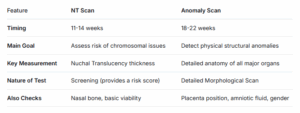
When is it done? Typically between 11 weeks and 13 weeks + 6 days of pregnancy.
Primary Purpose: The NT Scan is a first-trimester screening test. Its main goal is to assess your baby’s risk for certain chromosomal abnormalities, most notably Down syndrome (Trisomy 21), Edwards syndrome (Trisomy 18), and Patau syndrome (Trisomy 13). It is often part of the “First Trimester Combined Screening.”
What does it measure? The scan focuses on a specific area: the nuchal translucency. This is a small, fluid-filled space at the back of your developing baby’s neck. All babies have some fluid, but an increased measurement can be a soft marker for genetic conditions. The scan also checks for the presence of the nasal bone, as its absence can be another indicator.
How are results given? The NT measurement is combined with a blood test (analyzing pregnancy-associated plasma protein-A and human chorionic gonadotropin) and your age to provide a probability or risk score (e.g., 1 in 1500). It’s important to remember this is a screening test, not a diagnostic one. A higher-risk result usually leads to recommendations for diagnostic tests like CVS or amniocentesis.
The Anomaly Scan (Level II Ultrasound or TIFFA Scan)
When is it done? Usually between 18 weeks and 22 weeks of pregnancy.
Primary Purpose: As the name suggests, the Anomaly Scan is a detailed second-trimester scan aimed at checking for physical or structural abnormalities in the baby. It provides a comprehensive anatomical survey.
What does it examine? The sonographer will meticulously examine your baby from head to toe. Key areas of focus include:
- Brain, spine, and skull
- Face (to check for cleft lip)
- Heart (chambers, valves, and outflow tracts)
- Stomach, kidneys, and bladder
- Arms, legs, hands, and feet
- Placenta position, amniotic fluid level, and umbilical cord blood flow
How are results given? The scan provides diagnostic observations of your baby’s anatomy. The report will detail if all structures appear normal or if any potential concerns are noted. It’s also the scan where you can often find out your baby’s gender, if you wish to know!
Key Differences at a Glance
Why Both Scans Are Important
Think of these scans as a powerful, two-part screening process for your pregnancy. The NT Scan is an early checkpoint for genetic health risks. The Anomaly Scan, performed later when the baby’s anatomy is more developed, is a thorough physical examination. They are complementary, not interchangeable. One does not replace the need for the other. Together, they provide a more complete picture of your baby’s development and offer crucial reassurance to expecting parents.
Always discuss your specific medical history and any concerns with your gynecologist, who will guide you on the best prenatal care pathway for you and your baby.
Raaya Diagnostic Center – NT Scan & Anomaly Scan Center in Moshi
For expectant parents in Moshi and the surrounding region, Raaya Diagnostic Center stands as a trusted partner in your prenatal journey. Equipped with state-of-the-art high-resolution ultrasound machines and staffed by experienced, compassionate radiologists and sonographers, the center specializes in providing precise and caring service for both NT Scans and detailed Anomaly Scans (TIFFA). Understanding the significance of these moments, they ensure a comfortable environment where all your questions are addressed, and reports are delivered with clarity and expert consultation. Choose Raaya Diagnostic Center for advanced technology and empathetic care during these important milestones of your pregnancy.
Visit : Raaya Diagnostic Centre -Best CT scan, Sonography , X-ray, HSG, OPG & Pathology
Adddress : Gr floor, Kamalraj Datta Vihar Society, Central, Dehu – Moshi Rd, near Priyadarshini High School, MIDC, Moshi, Pimpri-Chinchwad
Contact Number : +91 9322822962
Frequentlt Asked Questions
1. What is the difference between NT scan and anomaly scan?
The NT scan (weeks 11-14) screens for chromosomal abnormality risk by measuring neck fluid. The anomaly scan (weeks 18-22) is a detailed check of the baby’s physical anatomy and organs.
2. Can anomaly scan detect Down syndrome?
An anomaly scan can sometimes identify physical “soft markers” associated with Down syndrome, but it is not a primary screening test for it. The NT scan and NIPT are better for initial Down syndrome risk assessment.
3. Which is more important NT scan or anomaly scan?
Both are critically important for different reasons. The NT scan is key for early genetic risk screening, while the anomaly scan is vital for checking the baby’s structural development. They are complementary parts of complete prenatal care.
4. What happens if NT scan is high?
A high NT measurement indicates an increased risk for chromosomal or heart defects. Your doctor will likely recommend further diagnostic tests, such as NIPT, CVS, or amniocentesis, for a definitive diagnosis.
5. Is anomaly scan done on empty stomach?
No, an anomaly scan does not require an empty stomach. In fact, having a meal or snack before your scan can sometimes help make the baby more active for easier imaging.